1

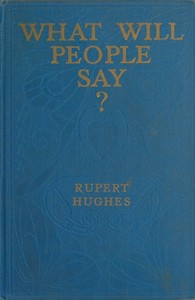
What Will People Say? A Novel — A Reader’s Guide
5
2
Project Gutenberg
2011
Triangles (Interpersonal relations) -- Fiction; Man-woman relationships -- Fiction; New York (N.Y.) -- Social life and customs -- 20th century -- Fiction
Readers of public-domain and historical texts
Project Gutenberg digital edition
en
Edition facts
Words: 155,491
Reading time: 677 min
Text sections: 15
Source:
Project Gutenberg record #38311
Rupert Hughes's 1914 novel uses the traffic of Fifth Avenue as a metaphor for social surveillance, tracing Lieutenant Harvey Forbes's return from the Philippines and his romance with Persis, a wealthy woman haunted by past poverty. The narrative moves between public spectacle and private fear, with recurring images of suffocation and exposure.
Editorial Edition Score
4.9/5
★★★★★
★★★★★
Calculated from edition completeness, EPUB availability, text structure and catalogue metadata. Not a user rating.
Edition quality
The novel opens with a striking simile: Fifth Avenue at flood-tide is a 'boiling surf of automobiles,' and the policeman who checks the sea with a nod or a jerk of thumb succeeds where King Canute failed. This image of controlled chaos sets the stage for a story deeply concerned with social observation and the power of public opinion. Lieutenant Harvey Forbes, just returned from policing Moros in the Philippines, sees the traffic officer as a fellow keeper of order, but notes that once the uniform is out of sight, 'all the clutches leaped to the high'—a truancy that mirrors the novel's central tension between private desire and public judgment.
The Traffic of Social Surveillance
The opening chapter establishes a structural pattern: the city itself becomes a mechanism of watching and being watched. Forbes observes that New Yorkers behave like schoolchildren, 'with joyous deviltry whenever and wherever the teacher's back was turned.' This analogy recurs throughout the excerpts, linking the regulation of automobiles to the regulation of personal conduct. The novel's title—What Will People Say?—is not merely a phrase but a governing principle, as characters constantly measure their actions against an imagined audience. The physical layout of Fifth Avenue, with its sliced-off sidewalks and lopped porticos, suggests a city reshaped by the demands of visibility, where even architecture yields to the need for unobstructed view.
Money as Atmosphere, Not Plot
Persis's long monologue about poverty reveals that the novel treats money less as a driver of events than as a pervasive condition of feeling. She recalls a year of 'skimp and scrape'—turning old gowns, giving up the opera box, selling saddle-horses—and describes the return to wealth as 'coming out of a cave again into the sunlight.' The language of suffocation is precise: imagining a life on two thousand a year 'was like a suffocation,' and she understands 'how a fish must feel when it is drawn from the water.' These recurring images of breathlessness and drowning link financial anxiety to physical panic, suggesting that the novel's psychological realism depends on embodied metaphor rather than economic argument.
The Dream of Ceremony and Its Collapse
Persis's fantasy wedding—with 'counts and barons for ushers,' an archbishop, and presents so glorious that 'everybody that gave them would be bankrupted for life'—is narrated in a breathless, accumulating style that mimics the pressure of social expectation. The passage moves from the specific ('a private car to a palace built brand new just for me') to a sudden deflation: 'It was a silly dream. It's not the ceremony that counts—it's the long life after.' This pivot from public spectacle to private reality echoes the novel's structural movement between the crowded avenue and the intimate conversation. The excerpt leaves unresolved whether love can survive the loss of display, but the emotional weight falls on the fear of being seen as a failure.
Watching the Soul in Debate
A recurring structural device in the excerpts is the silent observer. Forbes is 'fascinated with watching her soul in debate with itself' and does not speak, merely holding her fast and listening. This creates a pattern of asymmetrical revelation: one character speaks at length while the other watches, and the reader is positioned as a third observer. The novel thus builds its tension not through action but through the accumulation of such watched confessions. The final image of Persis putting his arms away 'as if they irked her and hampered her breath' returns to the motif of constriction, suggesting that intimacy itself can feel like a vacuum. The excerpts offer no resolution, only the repeated gesture of drawing back from the brink of disclosure.
Readers should attend to the way Hughes uses physical space—the avenue, the motor-bus, the pool where a woman stands revealed—as a stage for internal conflict. The novel's movement between public and private scenes is not merely scenic but thematic: each setting tests how much of the self can be shown. The excerpts suggest that the book's real subject is not the love story but the architecture of fear that surrounds it.
Reader reflection
How did this book work for you?
Your answers remain private and are stored only in this browser.
Your progress
0
/
10
2
What was your overall reaction to the book?
3
Would you pass this book on to a friend?
4
Did the language feel accessible?
5
Could you apply anything you learned?
6
What was its emotional impact?
7
Was the book moving at the right speed?
8
How understandable was the text?
9
What did this book teach you most?
10