
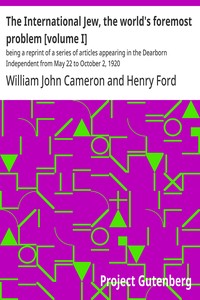
The International Jew, the world's foremost problem [volume I] : being…
Let's be clear from the start: this isn't a novel. There's no protagonist or traditional plot. 'The International Jew' is a compilation of articles originally published in Henry Ford's newspaper, The Dearborn Independent, in the early 1920s. The credited author, William John Cameron, was Ford's right-hand man. The 'story' it tells is a conspiracy theory, presented as fact.
The Story
The book argues that a secretive, powerful group of Jewish individuals controls international finance, the media, and even governments. It frames world events—like wars and economic shifts—not as complex historical processes, but as the deliberate machinations of this group. It takes real things, like the involvement of some Jewish bankers in certain loans, and twists them into evidence of a monolithic, evil plan. It's written in a tone that sounds authoritative and 'exposé'-like, which made it dangerously convincing to many readers at the time.
Why You Should Read It
You shouldn't read it for truth or enlightenment in the usual sense. You should read it as a cautionary lesson in how hate speech operates. Seeing how these ideas were packaged—not with crude slurs, but with footnotes, quotes taken out of context, and a veneer of seriousness—is chilling. It shows how bigotry can mimic scholarship to gain respectability. Reading it made me angry and sad, but it also helped me recognize the same rhetorical tricks when they pop up today, just with different targets. It's a masterclass in propaganda, and understanding that toolkit is more important than ever.
Final Verdict
This is not a book for casual enjoyment. It's for readers interested in the history of propaganda, media literacy, or the roots of anti-Semitism. It's crucial context for understanding the 20th century. If you pick it up, go in with your eyes open: you're not reading history, you're reading the source material for hatred. Have something hopeful lined up to read afterward. It's a tough, necessary look into a very dark corner of our past, reminding us that words, when weaponized like this, have real and devastating consequences.
This book is widely considered to be in the public domain. It serves as a testament to our shared literary heritage.
Barbara Flores
11 months agoSurprisingly enough, the pacing is just right, keeping you engaged. Don't hesitate to start reading.
Carol Lewis
1 year agoBeautifully written.
Kevin Jackson
1 year agoHaving read this twice, the depth of research presented here is truly commendable. Truly inspiring.
Betty Rodriguez
1 year agoThe formatting on this digital edition is flawless.
Ashley Moore
1 year agoVery satisfied with the depth of this material.