1

Ovington's Bank — A Closer Reading
4
1
Project Gutenberg
2012
England -- Social life and customs -- 19th century -- Fiction; Love stories; Banks and banking -- Fiction
Readers of public-domain and historical texts
Project Gutenberg digital edition
en
Edition facts
Words: 166,995
Reading time: 727 min
Text sections: 45
Source:
Project Gutenberg record #38990
In this 1922 novel, Stanley J. Weyman opens with a bustling market-day scene in Aldersbury, introducing Arthur, a confident young man whose pursuit of Jos unfolds against a backdrop of banking and social custom. The excerpts reveal a narrative focused on personal drama and period detail, but the catalog subjects—especially 'Banks and banking'—are only indirectly present.
Editorial Edition Score
4.9/5
★★★★★
★★★★★
Calculated from edition completeness, EPUB availability, text structure and catalogue metadata. Not a user rating.
Edition quality
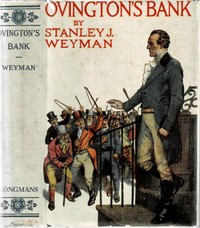
The novel begins on market day in Aldersbury, with the clock of St. Juliana’s about to strike three. The streets are thronged with gentry, farmers, and hucksters; a carriage and four with postillions in yellow jackets waits at the Post Office. Through this crowd moves Arthur, a young man in a blue coat with gilt buttons, greeting everyone with a laughing nod. The scene is dense with period detail—tandem-carts, pack-asses, low-browed shops—but the bank itself appears only as a location on Bride Hill. The catalog subject 'Banks and banking' is thus less a driver of plot than a setting detail, at least in the opening chapter.
Market-Day Setting as Social Canvas
The opening pages paint a vivid social tableau: white-coated yeomen jostle their betters, taprooms pour out those who have drunk deep, and the babel is loudest about the inn yards. Weyman’s prose lingers on the movement and noise—'chattering, moving multitude'—and on the precise dress and vehicles of the period. This is not a generic historical backdrop; it is a carefully observed social hierarchy in motion. Arthur threads through it with ease, his hat tilted back, greeting 'gentle and simple' alike. The bank, though named in the title, is merely one stop on Bride Hill, not yet a center of action. The catalog subject 'England -- Social life and customs -- 19th century' is richly supported here, but the financial institution itself remains peripheral.
Arthur’s Courtship and Jos’s Reserve
The later excerpt shifts to a garden scene, where Arthur, in high spirits after speaking to Jos’s father, presses his suit. He finds Jos leaning on a wall, a shawl about her shoulders, her eyes on the mill and the Thirty Acres. She is pensive and still; when he approaches, her color does not rise. Arthur, full of his purpose, sees only what he wishes to see. He takes her hand, speaks of having waited patiently, and recalls cutting their names on an old pew. But Jos protests, 'I had no idea'—a line that suggests a mismatch in expectations. The romance, cataloged as a 'Love story,' is clearly central, but the excerpts hint at emotional distance rather than mutual passion. The bank, again, is absent from this intimate scene.
What the Catalog Subjects Omit
The catalog lists 'Banks and banking' as a primary subject, yet in the two substantial excerpts provided, no banking business occurs. The bank appears only as a physical location—'the steps of Ovington’s Bank'—and as part of the title. The narrative energy is directed elsewhere: to market-day bustle, to Arthur’s confident stride, to the garden confrontation with Jos. The catalog also includes 'Psychological & Social Fiction,' which the excerpts partially support through Jos’s pensive stillness and Arthur’s self-absorption. But the psychological dimension is understated, conveyed through gesture and setting rather than interior monologue. Readers expecting a financial thriller or a deep character study may find the novel’s actual texture more social and romantic than the catalog suggests.
The excerpts from Ovington’s Bank reveal a novel that begins with a bustling social panorama and narrows to a tense courtship. The bank itself, despite the title, is a shadowy presence—a name on a building, a step to stand on. Readers should approach the book as a period romance with strong local color, not as a financial drama. The catalog subjects, while accurate in a broad sense, may mislead those expecting the bank to be a central mechanism of plot rather than a backdrop.
Reader reflection
What did you think of this book?
Answer a few questions and save a private reflection on this device.
Your progress
0
/
10
2
Did this book hold your interest?
3
Would you recommend this book to another reader?
4
How much effort did this book require?
5
How valuable was this book for your own interests?
6
How closely did the book connect with your experience?
7
What was its emotional impact?
8
How did the pace of the book feel?
9
In one sentence, what did you learn?
10