1

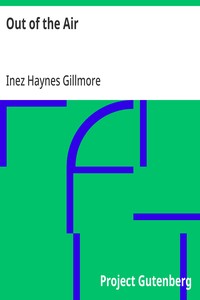
Out of the Air — Edition Insights
4
1
Project Gutenberg
2011
Authors -- Fiction; Love stories; Ghosts -- Fiction; World War, 1914-1918 -- Veterans -- Fiction
Readers of public-domain and historical texts
Project Gutenberg digital edition
en
Edition facts
Words: 53,290
Reading time: 232 min
Text sections: 12
Source:
Project Gutenberg record #38060
In Out of the Air, a war veteran and aspiring writer rents a historic New York apartment and encounters ghostly apparitions. The narrative intertwines his reluctance to fly again with spectral visitations, including a mysterious woman, a pigtailed girl, and a jovial bearded ghost, all tied to the house's past.
Editorial Edition Score
4.7/5
★★★★★
★★★★★
Calculated from edition completeness, EPUB availability, text structure and catalogue metadata. Not a user rating.
Edition quality
The novel opens with David Lindsay, a discharged World War I aviator, typing a letter to a friend named Spink Sparrel. He declares he never wants to fly again, vowing to confine his locomotion to the earth. The scene is set in a Washington Square apartment, described as a "key house of New York" with antique furnishings. Lindsay's attention repeatedly drifts from his typing to the doorway, as if expecting someone. This restless gaze establishes a tension between his present occupation and an unseen presence.
The excerpts reveal a layered narrative: Lindsay's mundane civilian life is punctuated by ghostly encounters. He describes seeing a little girl with pigtails dragging a rag-doll, and later a jovial, bearded apparition resembling a Titian portrait. These visitations are not presented as frightening but as inexplicable, prompting him to buy the house impulsively. The story balances psychological realism with supernatural elements, rooted in the aftermath of war.
War's Lingering Shadow
Lindsay's opening declaration—"I don't want ever to fly again"—immediately ties his identity to his war experience. He describes his last "pay-hop" and discharge papers, framing his return to civilian life as a deliberate retreat from danger. The phrase "God willing, I'll never again ride anything more dangerous than a velocipede" underscores a desire for safety, yet his surroundings are saturated with reminders of flight: the apartment overlooks Washington Square, and he later mentions a ghostly woman named Lutetia, whose name suggests a connection to Paris (Lutetia being the ancient Roman name for the city). The war is not directly depicted but permeates his thoughts; he admits he needs to "get that guerre out of my system." This internal conflict between past trauma and present calm shapes the narrative's emotional core.
Ghosts as Living Presences
The apparitions in Out of the Air are not conventional ghosts. Lindsay insists they are not dead but "alive somewhere," describing them as projections or "sloughed-off, astral selves." The little girl is depicted with precise, mundane details: pigtails, freckles, a rag-doll dragging on the floor. The bearded man is "jovial" and handsome, wearing a flowing gown and a small cap. These descriptions ground the supernatural in the ordinary, making the encounters feel plausible. Lindsay's reaction is not fear but "spiritual diffidence," a reluctance to intrude. The ghosts do not speak or interact; they simply appear, as if occupying a parallel space. This ambiguity—are they memories, hallucinations, or real?—invites readers to question the nature of perception and reality.
The House as a Character
The apartment itself is a focal point of the story. Lindsay describes it as "the key house of New York," filled with antiques like a sailor's chest and a butterfly table. He notes that Jeffrey Lewis once lived there, adding historical "connotation." The setting—Washington Square with its "formal garden" and "plumy treetops"—contrasts with the interior's chaste New England style. The house becomes a repository of past lives, and Lindsay's purchase of it after seeing Lutetia suggests an inexplicable compulsion. The ghosts are tied to the place: the little girl appears in the hallway, the bearded man in the living-room doorway. The house is not merely a backdrop but an active participant, its architecture shaping the encounters. This focus on setting reinforces the theme of lingering presences, both literal and metaphorical.
Readers should note that the excerpts provide only a fragment of the narrative, focusing on Lindsay's initial ghostly encounters. The full novel likely explores his relationship with Lutetia, the author of The Sport of the Goddesses, and the implications of the jovial ghost. Pay attention to how the war's aftermath colors Lindsay's perceptions and how the supernatural elements are woven into a story about memory, loss, and the search for meaning. The writing style blends brisk dialogue with descriptive passages, creating a tension between the ordinary and the inexplicable.
Reader reflection
How will you remember this book?
Save your reaction, strongest insight, and memorable passage.
Your progress
0
/
10
2
What was your overall reaction to the book?
3
Would you recommend this book to another reader?
4
What was the reading difficulty like?
5
Did it raise ideas you would like to talk about?
6
How would you rate its originality?
7
How much did the book move you?
8
How understandable was the text?
9
Which lesson or insight stayed with you?
10