1

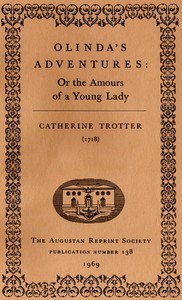
Olinda's Adventures: or the Amours of a Young Lady — Reading Notes
4
2
Project Gutenberg
2011
Young women -- Fiction; Love stories; Epistolary fiction
Readers of public-domain and historical texts
Project Gutenberg digital edition
en
Edition facts
Words: 29,108
Reading time: 127 min
Text sections: 4
Source:
Project Gutenberg record #37218
An epistolary novel from 1693, Olinda's Adventures traces a young woman's psychological turmoil in love, marked by jealousy, self-deception, and the tension between desire and reputation.
Editorial Edition Score
4.6/5
★★★★★
★★★★★
Calculated from edition completeness, EPUB availability, text structure and catalogue metadata. Not a user rating.
Edition quality
From its opening letters, Olinda's Adventures immerses readers in the volatile inner life of its heroine. The narrative voice oscillates between self-justification and raw confession, as Olinda records her reactions to Antonio's courtship with a blend of analytical detachment and emotional urgency. The prose captures the rapid shifts of a mind caught between hope and suspicion: she believes his vows one moment, calls him false the next. This psychological immediacy, unusual for early epistolary fiction, gives the novel a distinctly modern feel.
The Architecture of Suspicion
The excerpts reveal a carefully constructed pattern of doubt. Olinda's jealousy is not merely stated but dramatized through the rhythm of her thoughts. When she hears of another lady with Antonio, she writes with “affected coldness” yet cannot resist giving “dark Hints” of her knowledge. Her language betrays her: she claims to be forced into a meeting, but admits she was “glad of the necessity.” Trotter uses these contradictions to expose the gap between Olinda's stated intentions and her actual desires. The narrative lingers on the physical and emotional effects of suspicion—Antonio's “extasie of Joy” at seeing her, her own “Weakness” revealed by her rage. These details build a portrait of love as a battle for self-control, where every gesture is read for hidden meaning.
Epistolary Self-Fashioning
Olinda writes not only to chronicle events but to shape her own identity. The letter form allows her to present herself as both victim and agent. She insists she acted against her inclinations, yet the text undercuts this claim: Antonio “saw something in my Eyes which made him think, I was not very Angry.” Trotter exploits the epistolary gap between what Olinda says and what she reveals. The act of writing becomes a performance, with Olinda addressing an implied reader (perhaps herself) to negotiate her self-image. This self-consciousness extends to her manipulation of Antonio's letters, which she quotes and interprets. The novel thus offers an early example of how the epistolary mode can dramatize the construction of identity through narrative.
Tensions of Agency and Reputation
Throughout the excerpts, Olinda navigates a narrow space between social expectation and personal desire. She must maintain appearances before her mother, yet she schemes to meet Antonio privately. She claims to be “sorry to be forc'd to receive new Obligations from him,” but the phrasing suggests a convenient surrender. Trotter highlights the double bind of the young woman: to act is to risk reputation, but to refuse is to lose love. Olinda's jealousy itself becomes a social liability, as it “discover'd my Weakness the more.” The novel does not resolve this tension; instead, it dwells in the ambiguity, showing how Olinda's choices are never fully free. This nuanced portrayal of female agency within strict social codes marks the work as a sophisticated early novel.
Readers attentive to the subtleties of tone will find Olinda's Adventures a rewarding study in narrative unreliability. The letters demand close reading: what Olinda omits, what she protests too much, and where her language slips betray more than she intends. This edition preserves the original spelling and punctuation, which can slow the eye but reward patience with the rhythms of early eighteenth-century prose.
Reader reflection
Before you leave, reflect on the book
Use these questions to collect your thoughts before moving on.
Your progress
0
/
10
2
What was your overall reaction to the book?
3
Would you encourage someone else to read it?
4
What was the reading difficulty like?
5
Did the book offer a fresh perspective?
6
Would you start a conversation about this book?
7
How strongly did the book affect you emotionally?
8
What did you appreciate most?
9
Which lesson or insight stayed with you?
10